For gamers that really know their stuff, configuring TQoS s allow gamers to set online gaming traffic as high priority, ensuring bandwidth on both wired and wireless connections for prioritised applications. Specific tasks and applications can be prioritised via manual user-defined parameters.
Selecting TQOS, sets online gaming and web surfing as the highest priority, ensuring bandwidth on both wired and wireless connections for prioritised applications.
Specific tasks and applications can be prioritised via manual user-defined rules. This may include bandwidth rules for selected:
- Devices
- Ports
- Protocol
- Packet size
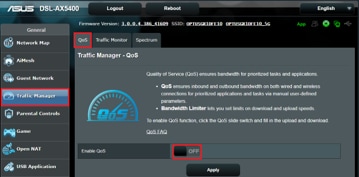
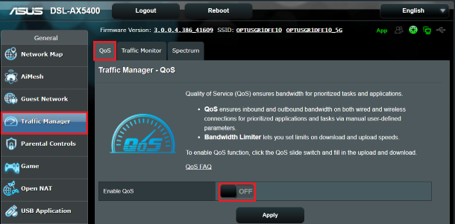
1. From the General tab, click Traffic Manager
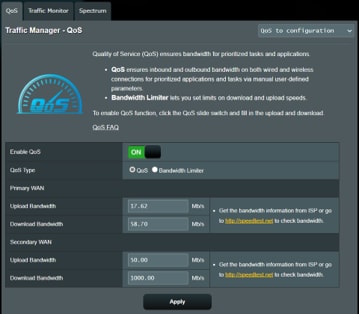
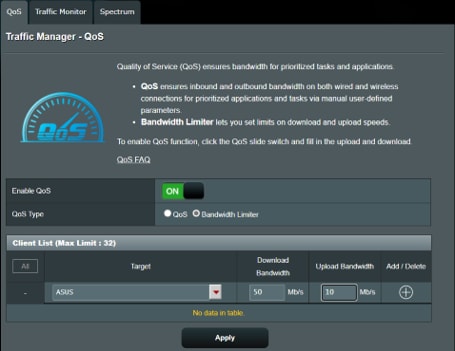
2. Select QoS as QoS type (your modem will now restart)
3. Define upload and download bandwidth. By default settings are set to:
- Primary WAN = DSL WAN
- Secondary WAN = Ethernet WAN
As QoS will not work unless both upload and download are defined for both connections, simply fill in anything for the other connection that is not connected.
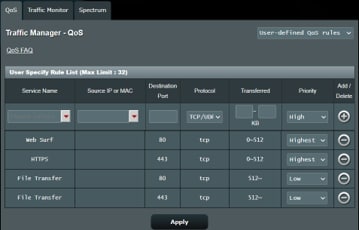
4. Under User-defined QoS rules, you'll find the default QoS rule. See below for must fill parameters:
- Service Name: Can be anything, for your own reference only. Not a Must Fill parameter
- Source IP or MAC: Fill only if you only want to apply this on a specific client. Rule applies to all client if not filled
- Destination Port: Fill only if you wish to apply restriction over traffic utilizing specific port for transmission. Rules apply to all ports if not filled
- Protocol: Defines the protocol which the restriction should be applied to
- Transferred: Fill only if you want to apply only when the transmission is within a specific size range. Rules apply to any size transmission if not filled
5. Click + to add this new rule
.
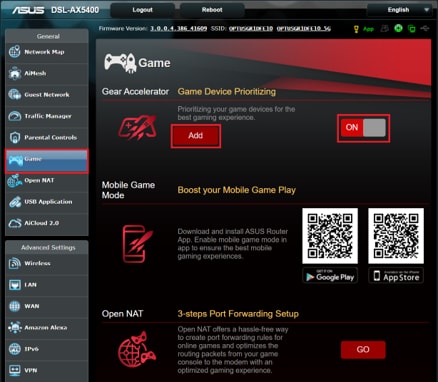
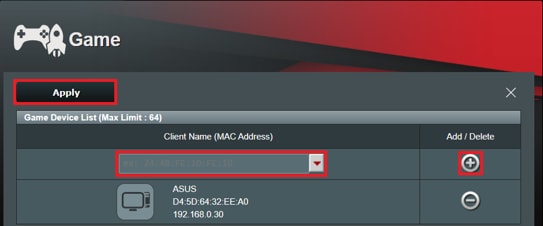
Note: When both Gear Accelerator and QoS are enabled at the same time, the changes made to the game device list of Gear Accelerator will be synchronized to Traditional QoS, whether that is add or remove, replacing the existing configuration.
If these devices were added by Gear Accelerator, they will appear in Traditional QoS as top priority device without consideration of traffic type, port or data size.