2023 FIFA Women’s World Cup - presenting a new digital direction
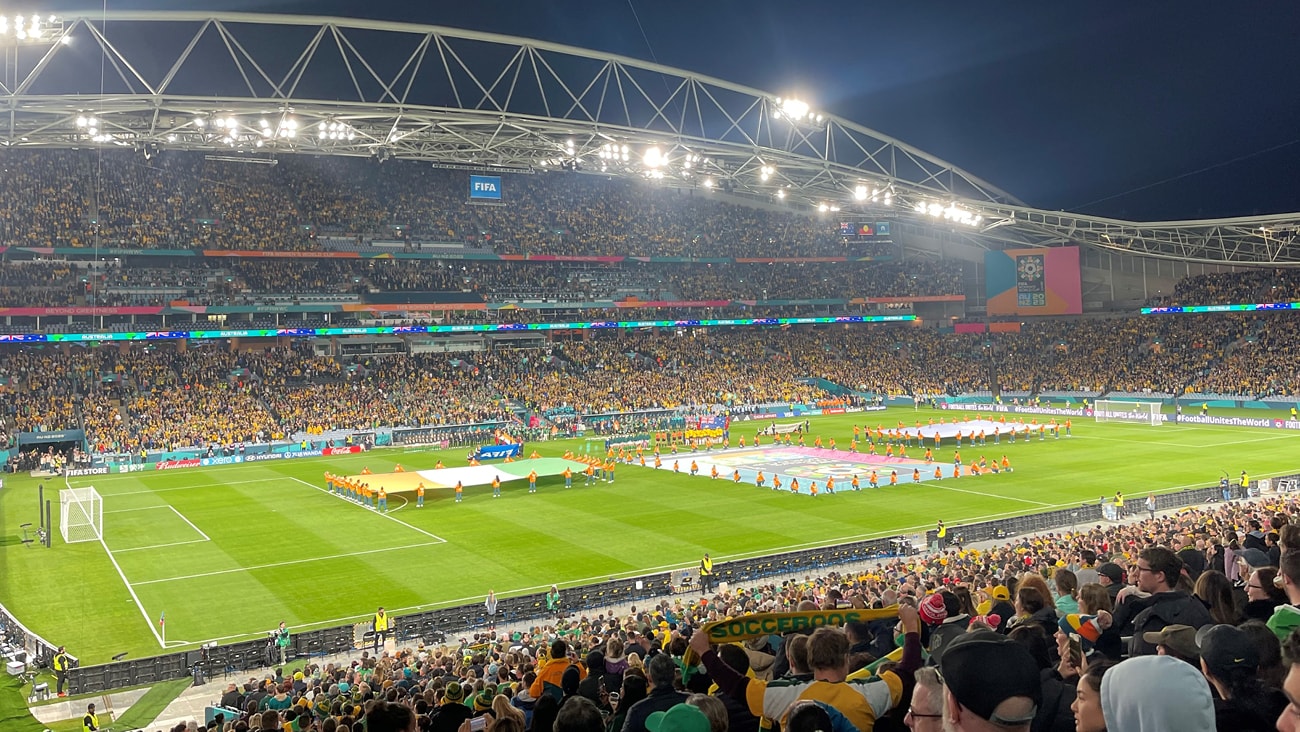
Image Source: Australia vs Ireland at Accor Stadium, Sydney
Beyond the outstanding success of the Matilda’s, one of the more fascinating and unexpected outcomes from this 2023 FIFA Women’s World Cup was the increased use of public spaces supporting streamed live action on large format screens to watch and participate in the action.
While stadium attendances and television ratings broke all records, sites such as Federation Square in Melbourne, Darling Harbour in Sydney and South Bank in Brisbane saw equally impressive fan participation. As the world cup event rolled forward and we rode the wave of enthusiasm of the Matildas’ success, the finals saw the opening of more public space venues. King George Square and the Riverstage in Brisbane, Allianz Stadium in Sydney and AAMI Park in Melbourne became draw-cards for fans of all ages.
During games, coverage shown in the stadium often crossed to one of these public space venues escalating the community spirit. The large format digital screens allowed fans to watch the event together with their new found friends or individually via their own personal device.
These venues effectively represented an extension of the stadium, taking the opportunity to broaden the fan experience and audience participation into community-located venues. What’s apparent here is a penchant for people to participate as a collective.
The experience in a public space, surrounded by like-minded fully engaged fans is very different to watching events at home. From the FIFA experience we know this works: an outdoor venue where we feel like we’re part of an engaged community, all supporting the Matildas and, more importantly, the event facility itself.
This looks forward to a time where potentially all major events are broadcast in this manner: fans at the event, joining friends at a public outdoor site or at home. It's the difference between simply watching and collectively participating.
Image Source: Australia vs Ireland at Accor Stadium, Sydney
A feature of the Brisbane 2032 Olympic and Paralympic Games is the plan for the current Gabba to be replaced by a stadium accommodating 50,000 people - relatively small in comparison to historical events globally. (Sydney's Olympic Stadium accommodated 120,000, later reduced to 80,000 once the Games concluded.)
The decision to build a stadium of this capacity for the Brisbane Olympics is a sensible one: right-sizing the venue for the city, appropriately sized for future events. It represents an opportunity to extend the stadium experience to other public spaces, to live stream events from the stadium into venues across the city, state and nation, and to provide an opportunity for communities across Australia to actively participate.
Additionally, the Brisbane 2032 Games Venues are not co-located in one region. Venues are planned across a number of populated locations – Brisbane, Sunshine Coast, Gold Coast, Townsville, Cairns – meaning travelling to attend multiple events on the same day will not be possible.
Public spaces can be of service here, providing fans the opportunity to attend an event at a Games venue and then attend a local community public space to experience other events. Seamless and reliable connectivity that enables a spectator to leave one event at say, the Gabba in Brisbane, and join more fans to become engaged in another event live at a nearby public space, without the need for a significant commute to another Games venue. There is strong expectation that we will see the activation of multiple localised community spaces, enabling far broader and more diverse spectator participation than any other games in the past.
Simultaneously, fans attending stadiums want an outstanding digital experience while also having the opportunity to get more engaged in the action.
This represents a new paradigm in thinking.
Stadiums and live venue sites need to be able to provide fans and audiences with an outstanding personal digital experience. At the technology level, as we saw during the FIFA Women’s World Cup, this meant providing access to as many as 80,000 individuals inside a stadium, all seeking to share videos and photos, posting, connecting, talking and ordering refreshments. This makes for an outstanding local fan experience.
In the case of Accor Stadium at Sydney's Olympic Park, an In-Building Coverage (IBC) solution must deliver fast connection speeds of up 200 megabits per second to deliver the seamless experience expected by ticket holders.
Image source: Optus Director of In-Building Coverage Solutions Elie Abouhanna inside the Accor Stadium 5G IBC equipment room (R)
Asset managers want their spaces, precincts and stadiums to be full of people. To do that, they demand improved mobile networks that deliver secure, reliable connectivity in ways that go far beyond what's been previously available.
Additionally, fans are seeking an increasingly immersive experience: the ability to track their favourite player or get insights from their favourite commentator, reporting and sharing athlete information such as data points, real time telemetry and statistics, alternative viewing angles, and more.
To deliver these experiences, asset owners and event organisers need to transfer and expand more and more of that live experience beyond the stadium. This will include in-game statistics, tagging favourite players to then share their on-field experiences, and more.
That same experience – both in the stadium as well as on the field – can be extended to public spaces and live sites, creating new opportunities for asset owners and surrounding local businesses.
Optus’ work with the Brisbane Powerhouse Night Feast event held in March this year is one example. Taking the concept of providing premium food and an art experience, together with a special event and a wireless network that delivers a great customer experience, allows new business opportunities to start becoming realities.
Image Source: Brisbane Powerhouse Night Feast: Autumn 2023
This requires a robust wireless network capability that can handle and deliver huge amounts of real-time data, including the ability to scale in real-time.
Public spaces, precincts and commercial real-estate are now potentially in competition with other forms of real-time experiences. It's a situation that encompasses where and how people are entertained and how they enjoy themselves as much as where they work.
Asset owners and their tenants, whether businesses or sporting or cultural events, will compete with the convenience of delivered stay-at-home online access. Despite this, people are seeking the excitement and community participation that only the live experience can provide. It is connectivity technology that provides asset owners with new ways to attract audiences with enhanced and exciting experiences.
As a template for future events, there are several aspects to focus on when considering the future use of commercial real-estate assets:
- Connectivity: The nature of the coverage within the structure, which will require 5G to allow flexibility and scalability, but also outside the structure, to create precincts that can deliver new experiences to customers.
- The expectations and needs of customers: Whether for sporting events, shopping experiences or work, this will increasingly include the ability to share experiences, transact, and consume increasingly vast amounts of information.
- Engagement: Using connectivity to attract customers to a location ahead of an event, and connecting and engaging with those customers once they arrive. Asset owners must ask how they can create new engagement models for business partners based on a captive audience.
- Real-time mobile data analytics: Understanding who individual customers are, where they have come from, and their purchasing and usage habits. Of specific importance is coordinating and managing travel and commutes to and from locations, as well as planning future developments such as public infrastructure.
The FIFA Women's World Cup experience demonstrates what works. People will go to an outdoor venue if they’re part of a common community experience in ways that go beyond merely watching an event on a screen. If the experience is a seamless and positive one, they will be prepared to enjoy the experience without being inside the main stadium or venue.
If you would like to continue this conversation further, please reach out to your Optus Account Manager and request a call back below.



Ross O'Toole Industry specialist, Property & Retail
Ross is the Industry Expert for the Property and Retail vertical within Optus Enterprise. He is responsible for finding new opportunities at the intersection of technology and physical space, and develop new solutions for customers to create new value for these important business assets.
Sign up
Want to hear more from Optus Enterprise, sign up to receive the latest news and insights sent straight to your inbox.