The images below show a sample of a typical bill. To find out more about an item on the bill, refer to the number next to that item.
Note that the bill image below is not your actual bill. It has been provided for illustrative purposes only.
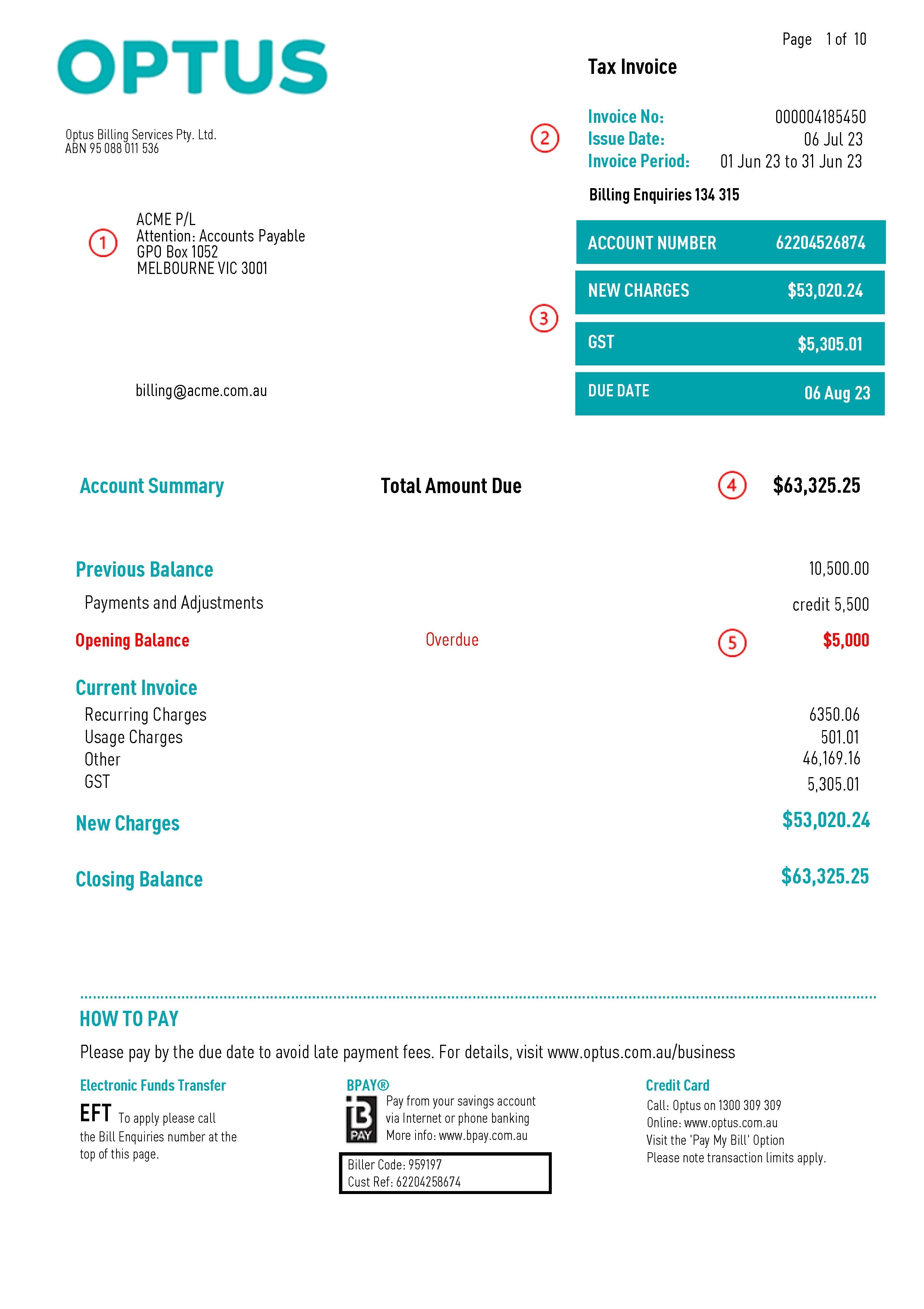
1. Name and address details: Email address (that invoice might be sent too) This can also include other relevant billing data for your team e.g. Purchase Order Number, Contract Reference, Building Name etc.
2. Invoice Number: Unique invoice reference number for this bill.
Date: The date the invoice/bill was issued.
Invoice Period: The period that the charges apply to.
3. Customer Account Number: This, coupled with your Invoice Number, allows us to pinpoint any charges that you may be enquiring about.
New Charges: Charges for services charged on page 4 or the current period.
Due Date: The latest date that payment should be made. This is static at 30 Days or as otherwise set out in your contract.
4. Total Amount Due: This includes new charges and any overdue/brought forward/opening balance.
5. Opening Balance: This is the total value of overdue amounts that have remained unpaid from previous bills. Any payments made 5 days prior to the issue date will be included in the current invoice (excluding bank processing times).
Cannot find what you're looking for? Please contact the Optus Service Desk or log an enquiry via My Business Portal
Pro-Rate Calculation – Bill Type 1
- $Total charge (ex GST) = $MRC - if the service start date is before the billing period of the current month
- $Total charge (ex GST) = ($MRC *NAD/NTDM) + $MRC - if the service start date is in the billing period of the current month
- $Total charge (ex GST) = $MRC *NAD/NTDM - if the service terminated date is in the billing period of the current month
Where
- $MRC = monthly recurring charge (ex GST)
- NAD = Number of days the service is active in the current billing period
- NTDM = Total number of days in the current billing periodOther Charges & Credits: These are one-off charges or credits applied to your account. For example, establishment charges