Hot property: addressing climate change in the building & construction industry
By Optus Enterprise and Business
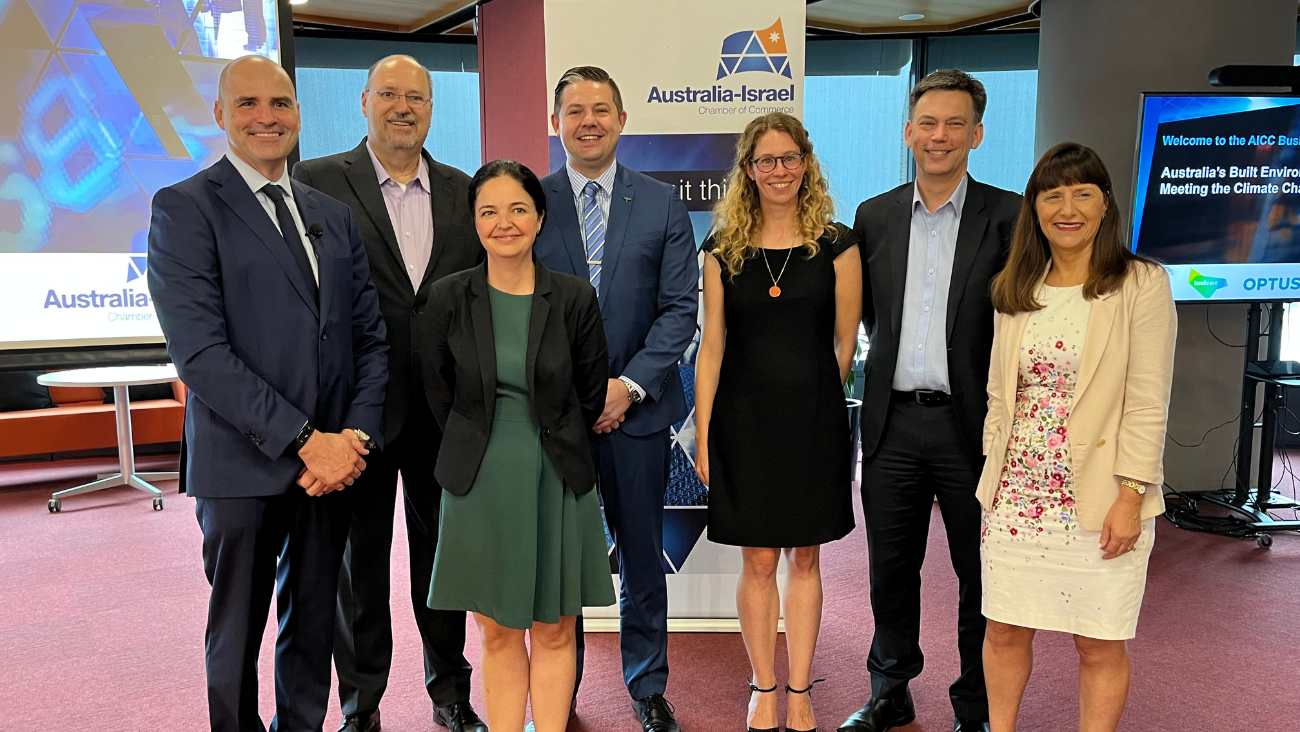
With the building and construction industry responsible for 39% of global energy emissions (11% from construction and 28% from running costs and energy usage), there was a lot of interest in the recent Australia-Israel Chamber of Commerce (AICC) business briefing on Decarbonising Australia’s Built Environment with nearly 100 attendees from all areas of industry.
Hosted at Lendlease Global Headquarters in Barangaroo and moderated by Optus Property & Real Estate Industry expert, Ross O’Toole, we heard from a panel of four experts on the future of sustainable construction.
It's a topic of pressing interest given that operating emissions and the often-hidden carbon emissions embedded in construction materials remain a significant challenge for the sector. This, coupled with the recent passing of the Climate Change Bill 2022 into Australian legislation, means that the industry needs to step up – and step up fast – if it is to reduce emissions by 43% by 2030 (from 2005 levels) and reach net zero by 2050.
There’s just seven years for those operating in the built environment or property asset management to meet the government’s ambitious targets. And the very first deadline is October this year when the National Construction Code Residential Energy Efficiency commences. These changes aim to increase the level of thermal comfort and reduce the cost of installing on-site renewables and electric vehicle charging nationwide. In addition, the building and construction industry in NSW will need to disclose embodied carbon information for residential and non-residential buildings as part of the updated Sustainable Building State Environment Planning Policy.
Australia is making good headway on renewable energy, the Chief Executive of the Climate Change Authority, Brad Archer, told the AICC event. With annual emissions today of 500mt CO2e and a year-on-year reduction of 12mt, much more still must be done to reach the new targets. Annual reductions need to increase to a whopping 17mt per annum – as a bare minimum. Electrification and digitisation of the built environment will be key to accelerating the pace of emissions reduction, he told the session.
Chief Executive of the Green Building Council of Australia, Davina Rooney, called out embodied carbon as “the elephant in the room” as it accounts for 80% of the building sector’s emissions. Re-use and re-purposing to reduce embodied carbon – in other words, the adoption of a circular economy – will have a key role to play here.
Another way Australian industry could approach the challenge is to follow the example set by countries including Denmark, Norway and Finland, said Charlotte Bizeau, Accenture’s managing director for real estate for APAC.
These countries have policies to measure a building’s threshold for carbon emissions over the building’s complete lifecycle – from its initial construction to its decommissioning or end of life.
In essence, it’s like having a carbon budget for a building’s entire life and having to be careful when and where this is spent. This means that the building’s carbon footprint needs to be at the centre of all decision-making – not just an afterthought, far down the track.
This is something very familiar to Lendlease, which as a company is already going far beyond what is required by industry today. As Lendlease’s CEO of Digital, Bill Ruh explained at the AICC event, their Podium Property Insights dashboard provides insights on the use of electricity, water, waste and other inputs that generate carbon usage, helping property owners to monitor their assets’ sustainability performance over time.
Any meaningful progress towards becoming “Net Zero ready” not only means moving away from fossil fuels, but also adopting real-time monitoring via the Internet of Things (IoT). Only by measuring what is happening now is it possible to improve in the future.
While all organisations are at different stages and may have different immediate priorities, connectivity is the foundation upon which IoT is built, whether it is via the mobile network, fixed infrastructure or in-building coverage.
Whether it is via legislated requirements for carbon emission reductions (“the stick”), inducements in the form of reduced costs, operational efficiencies, an enhanced user experience (“the carrot”), one thing is for sure: 2030 is just seven years away and we all need to start now (“the tambourine”).


Optus Enterprise Optus Enterprise is the enterprise division of Australia’s second largest telco. Our expertise spans across smart networks, mobility, digital transformation, ICT solutions, cloud and cyber security.
Sign up
Want to hear more from Optus Business, sign up to receive the latest news and insights sent straight to your inbox.
No question too small
Speak to one of our enterprise specialists over the phone on 1800 555 937 or via the link below.
To adapt to rapid change, you need more than technology
10 September 2026
Ask any enterprise leader about their five-year strategy and they’ll tell you the same thing: static roadmaps are dead.Boar...
Marist180 x Optus: The hidden cost of disconnection
9 September 2026
When Australians think about connectivity, they often think about convenience. Streaming a movie. Joining a Teams meeting. ...
Project Aurora: Smarter Satellite Servicing for a connected future
12 August 2026
For decades, the satellite industry followed a simple model: build a satellite, launch it into orbit and operate it until i...