Families that meditate together, stay calmer together
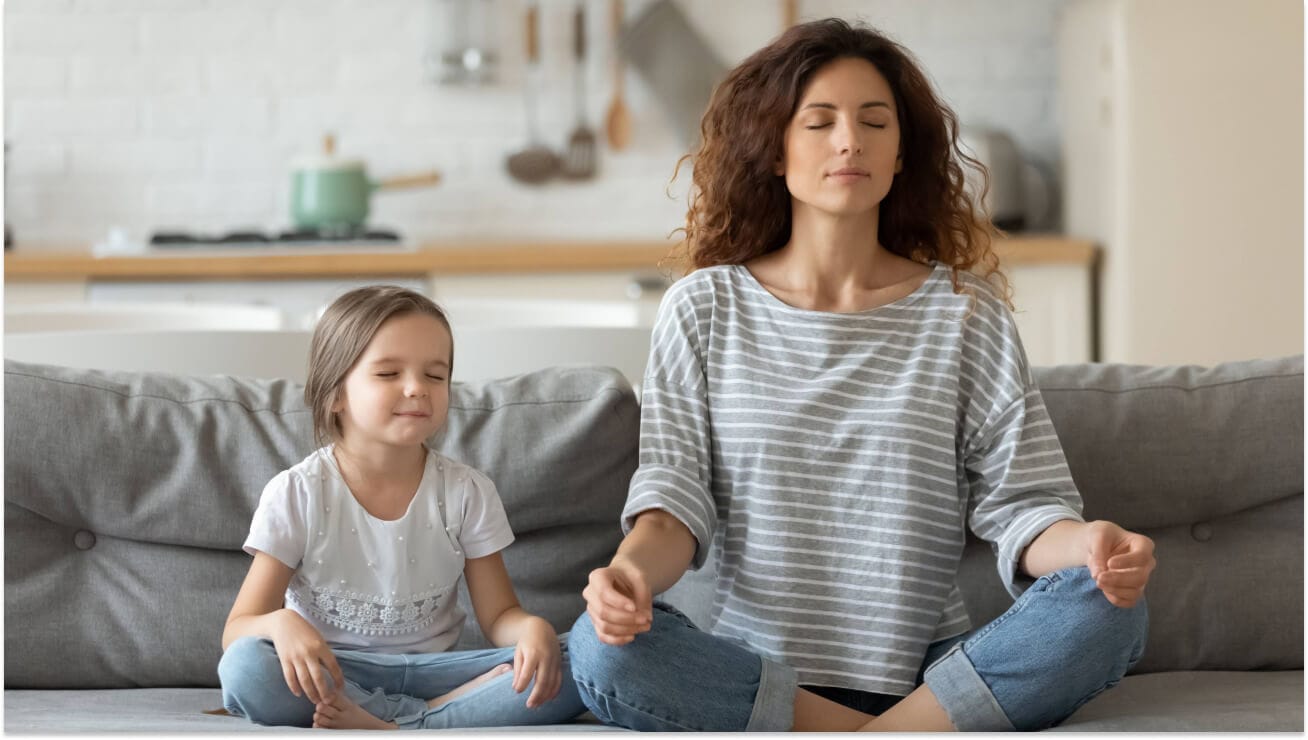
Image credit: iStock
Meditation can help all the family stay calm and focused. It can even help to improve both your mental and physical wellbeing.
What with the pressures of working from home or worrying about lost income, homeschooling, caring for toddlers and for the older generation; it can all seem a bit too much and overwhelming.
That’s where meditation can help to anchor and calm our minds which seem so full of tactical concerns and worries like, “Has Jack done his homework?” or “Do I look presentable enough for the Zoom meeting?”.
No one would blame you for feeling like a mouse trapped in an endless wheel. Your mind’s racing ahead, but it feels like you’re not getting anywhere. Not fully effective at work or play. Yikes.
Now breathe…
Most people have heard meditation and mindfulness can help improve your mental health. You might think that’s just for people who have lots of time on their hands. After all, you can’t just sit there just concentrating on your breathing when you’re so busy, busy, busy, right?
Well, it turns out it’s one of those counter-intuitive things in life. Slowing down and meditating can actually help you do more in your day. After all, if you’re calm you can think more clearly, and panic less so you can better handle a full-on day.
There are real benefits to meditation and mindfulness that can help everyone in the family. It need not take a long time. You’ll feel recharged and better able to tackle your day once you’ve shut out the unnecessary noise.
All upside – benefits of meditation
According to this study mindfulness-based stress reduction can improve anxiety, depression and reduce pain. It can even lead to changes in your brain and can help any age group or demographic. Any age group can use it to reduce anxiety, particularly during the pandemic.
To find out more we interviewed our very own Pinki Bathla, Senior Product Designer in the Optus Digital Service area. Pinki is also a meditation teacher who has generously offered her time to Optus employees during a weekly meditation class since July 2019 (online during COVID).
Now let’s allow Pinki tell to you a bit more.
Pinki, what’s your definition of meditation?
To me, meditation is a thoughtless awareness. When there are no thoughts, our mind is fully in the present moment. It starts with a practice until it becomes our state of being. When you disconnect yourself from the past and the future, you can fully embrace the present.
This can be achieved through many means. In my sessions, I blend several types of meditation techniques and mindfulness practices including body stretching, guided meditation, progressive muscle relaxation, light yoga, present moment awareness and, of course breathing.
Meditation allows you to connect with yourself - a space full of bliss and silence. You feel internal peace. That’s meditation.
There’s a famous quote “The best way to meditate is through meditation itself.”
What’s the difference between meditation and mindfulness?
When we see reality as it is without making an effort to change it, that’s mindfulness. You’re fully aware of the present moment, breath, movements, sensations, feelings, thoughts, emotions, environment etc. You can practice it anytime and anywhere, being fully engaged in here and now.
Meditation is a formal practice that we do to achieve a state of bliss or being. There are many different meditation techniques to expand your awareness such as breathing, loving kindness, mantras, visualisation, body awareness, and progressive muscle relaxation.
And when you’re in the present moment, you connect better with your family, achieve work-life balance and feel more compassionate to your loved ones and people around you.
Why is breathing so important in meditation?
Breathing is central to meditation. During my sessions, we anchor our attention back to breath to refocus our mind from its scattered pattern of thoughts. We can do this in our daily life as well, even when we’re not in class. Just close your eyes, take a deep breath, and feel the difference instantly.
Sorry, what do you mean by that?
Well, consider that your breathing patterns can change according to your emotional state or situation. When you’re anxious, it’s shallow and rapid; when you’re relaxed, it’s deeper and less frequent. Your breath knows about your emotional state before you do! You may not be able to change the situation, but you can change your breath and feel better.
No wonder, mothers about to give birth are told to “Breathe…”
Yes! Once you take a deep breath the pattern of your breath changes.
Focusing on breath helps your body to relax instantly. Breath is a bridge between your conscious and unconscious reality. It lies in between our thoughts and our physical, emotional, mental and cellular selves.
A great sage has quoted “Breath and mind arise from the same place and when one of them is controlled, the other is also controlled.”
Can any age group benefit from meditation?
Yes, Meditation can help any age group or demographic. If you can breathe you can meditate.
What about kids and teens?
Kids are natural meditators as they always live in the present moment. You can encourage your kids to join you while meditating. Parents can also make it playful. For example, guide kids to raise their hands and breathe in positivity and bend towards the floor and then breathe out all the negativities - an important life lesson.
It has many benefits on the kids including good sleep, better focus and calm mind.
And when you’re a teenager, you need more balance, focus and resilience. If you introduce meditation techniques, you can better handle this time in your life where things are changing rapidly, and you need clarity and inner strength.
Many adults have tried meditation in some form – what are some of the benefits for this age group?
After your turbulent teens, you transition to another complex stage of your life in which you’re facing relationship, growth and work-related challenges. As adults, we actually become less resilient because we try to control situations that are often beyond our control.
At this stage, meditation can help you become more grounded, balanced and can help you manage your stress levels, so you can make better choices in your life and have more gratitude, acceptance, and forgiveness.
When you accept things as they are, you stop wasting so much emotional energy. You can let things happen the way they have to happen. I’d advise everyone to stop wasting energy on opposing reality and can apply it to other aspects of your life, be more creative.
Don’t waste your energy on something that’s not in the present. The past and the future are non-physical dimensions only. NOW is the only moment we have.
What about older people who may not be at all familiar with meditation?
Older people have different challenges as they come into the last stages of their life. They may experience fear, loneliness, health issues and depression. They’ve seen a lot in their lives and are much wiser. But they may have lost themselves in the roles they played in their life. They just want to have better sleep and preserve their health.
Older people can meditate even if they’ve never tried it before. Meditation is about meeting yourself; you’re not acquiring anything new. Dig deep, and you find yourself to discover a calmness that can enrich your later years.
How can people get into meditation?
Regular practice and self-discipline is the key to meditation.
Be curious! There are so many techniques such as body scanning, visualisation, loving kindness, resting awareness, self-reflection, mantras, Transcendental meditation and yoga. Explore and take up whatever touches your heart.
In our class, we do a mix of techniques listed above. We also cultivate some positive emotions like compassion, letting go, gratitude and forgiveness.
You can introduce mindfulness into your everyday life. Mindful communication with your family members where you’re giving space while listening to your loved ones, eating mindfully and instilling an atmosphere of trust that can help the whole family. It can help heal and build relationships in your family unit.
Thanks Pinki!
You’re welcome, I hope this can help people in some way to find some inner calm.
Find out everything you need to know to connect your family safely to our network.
Connect and build your ideal family home with Optus nbn home plans. Get more choice with Optus Home Internet. The home of better internet.
Making sure your family takes a digital breather regularly is important. Press “pause” on the home’s WiFi during your family dinner time with Optus Pause and turn attention to valuable real-life conversation rather than online chat.# Free for eligible Optus customers via the My Optus app.
#Optus Pause: T&Cs and eligibility criteria apply. Select modems only.
EOFY scams: how to stay safe
7 October 2026
Stay safe this EOFY season – protect yourself from EOFY scams and read up on the tactics of scammers.
Optus Digital Thumbprint teams up with Hoops 4 Health to keep young people safe online
2 July 2026
Optus Digital Thumbprint and Supercars star Chaz Mostert helped deliver a Hoops 4 Health session in the Top End, empowering...
Donate Your Data. Help Change Lives.
23 February 2026
When people think of hardship, they don’t always picture Australia’s Northern Beaches. But behind the coastal postcard lies...