Hi everyone.
I'm delighted to be here today to talk
about a really important topic which is well being for small businesses.
And before we start, we're filming today in Barangaroo in Sydney, and I wanted to take a moment to pay my respects to the Gadigal people of the Eora Nation, the traditional custodians of this land, and to pay my respect to their elders, past and present.
I also wanted to acknowledge an important figure in the history of this area, a powerful Camareagle woman named Barangaroo after who this area is named, and I wanted to pay my respects to her and the lasting legacy she has created.
The theme for today is focused on the mental health challenges of running a small business and what that means for the people involved.
Now, running your own business has some fantastic benefits. It is rewarding, it can really connect you to a strong purpose.
But it can also at times be isolating, overwhelming and lonely.
Today, with some outstanding guests, we're going to share tips and tricks, stories and strategies for small businesses to help really connect with some strong ways that you can safeguard and build your mental health.
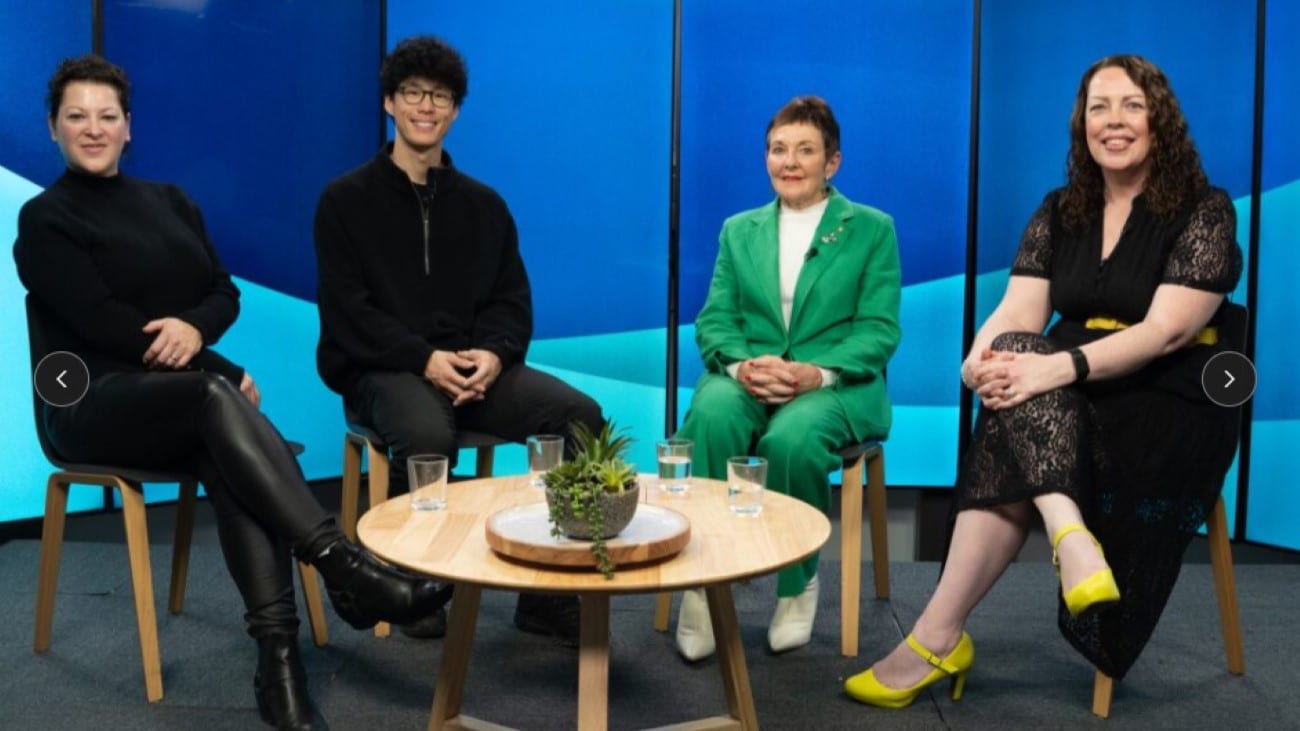
Welcome to Sam Finnegan, to Nathan Yoon and to Kate Carnell.
Thank you for joining us, guys.
So I'll start with Kate. So you have long been an advocate for small businesses. Tell us a bit about yourself and why mental health is so important to you.
I'm a pharmacist by profession. I bought my first pharmacy when I was in
my mid 20s and had a number of pharmacies over the years.
So I'm a small business owner, but I actually experienced a mental health problem myself when I was a teenager.
I had anorexia, so I'm a pharmacist, community pharmacist, dealing with people all day that have mental health problems because remember, one in four Australians will experience a mental health problem at some stage in their life. And in any one year, one in five will.
So people are thinking about their businesses, They're going to have staff often that are that are struggling a bit.
So for me, I've been around small business.
Mental health is, is just fundamental, I think to running a good business, but also having a decent life.
From there I got involved with Beyond Blue and being CEO, being chair, being deputy chair, all sorts of things over lots of years, as well as many small business things like small business ombudsman, those sorts of jobs.
So small business and mental health is what I've done that's amazing.
And it's, it all is often through the connection with things that happen to ourselves that we can really feel and experience and then take that knowledge and experience out.
So thank you for sharing that.
On to you Nathan.
Welcome. It's so good to have you here today.
So you are the Co founder of Peer, an outstanding clothing company, but also the winner of not one but two Smart 50 awards last year.
Tell me a little bit about your business and also why it's such an important topic for you.
Thanks for having me.
I'm Nathan. I am the Co founder of Peer.
We are fabric technology business that creates essentials that are functional, comfortable and sustainable.
We do have a range of products from socks, underwear, T-shirts to all the clothes I'm wearing today and we've been around for five years.
Personally, I've worked pretty hard throughout my life and I have experienced a lot of ups and downs with my mental health and I find it really,
really important in my current work.
And, and I've been, I guess advocating a lot about mental health through my actions and through my work with PER and just safeguarding everyone else's mental health on the same.
Really.
Yeah, yeah, absolutely.
I'm Sam, someone who I know well with an amazing business that I also know called Madebox.
It's been a journey for you over the last five years as you've established your business. Tell us a little bit about Made Box.
And again, why is mental health such an important topic for you?
Thank you, Emma, I'm really happy to be here.
So my background is in media, advertising and commercial partnerships for the last 20 years.
And I started made made box during COVID because we, if you remember, we just come off the back of the bushfires, we're in lockdown, there was no tourism and small businesses.
It's hard enough to run a small business, let alone then run that during all of these other external factors that influence your ability to run that business as well and you face closure.
So I knew a lot of businesses wanted to show support and there were there were consumer sites like Buy from the Bush and Film My Esky, but there was nothing that made it easy for businesses to show support for small.
So we curated a whole range of really exceptional Australian made products from small batch makers around the country and curated those into gift boxes.
And the we have a huge focus on telling their story.
So everything is about the story of where that person comes from and what the passion is that they have for those products.
And then we sell to large brands who then get benefit from not only showing their brand values in the support of those businesses, but these businesses have the chance of getting in front of new customers that didn't know they existed.
So the mental health duty that I take from this is that what we do is focused on helping the growth of these businesses.
And it's we see that because we know their stories.
We see the impact that we can actually have on a small business when they know that there's somebody else in their corner and that's something that we build the whole culture around.
That's great. Thanks, Sam.
I want to start with some questions just around the challenges that small businesses face but can be quite unique to them. And I start with UK.
As someone who has advocated for a number of years for businesses, I'm curious what you see as some of the key challenges that our small business owners and leaders face, and particularly as you go through their journey from starting up and then ongoing as they try and scale.
Well, first of all, 97%, in fact more than 97% of Australian businesses are small businesses.
Big percentage of them are sole proprietors, but then the rest less than 20 employees.
So this is a very large number of businesses in Australia.
People start up a business because they're passionate about something.
We've heard two passion stories already that they really want to make a difference and they want to be their own boss.
The problem is the things that happen in small business are almost impossible to predict.
And this big thing called cash flow is such an issue in small in small business.
You know, I don't want to quote stats all day, but 45% of small businesses pay
themselves less than the minimum wage.
Why?
Because they're putting the money back into the business the whole time, which is what you've got to do. There's no doubt about that.
But therein lies the challenge. People are good at what they what their
small business does, but around the small business comes staff, HR, getting the right people, cash flow and things that happen.
COVID would be a great example that you could never have predicted. So there's the challenge.
You can be good at the thing that you're doing in your small business, but around it, to be successful, you've got to be an expert in a whole range of other things.
Yeah, which are not necessarily the passion that you got into business to start with.
No, I don't think too many people say I want to go into business because I want to deal with the ATO more efficiently.
I don't.
I've never heard someone say that. Really.
No, not yet.
That would be your first.
That would be.
So.
Look, there's a lot of things you got to do that have got nothing to do with your passion, the reason you're running a small business.
But if you don't do it, you're in a world of trouble.
Yeah, absolutely.
And Nathan, I was, I was keen to understand with five years under your belt as a Co founder with payer, what have been the highs and lows of that
journey?
Well, obviously there was a lot, but going back to how small, medium sized businesses often face a lot of stress, cash flow, you know, as Kate said,
this is one of the biggest things that we're always facing with stress.
You get the good times where you know, end of financial year or like Christmas time, of course it's a good time.
But there's also all the other low seasons where you might see a downturn in economy and that usually strikes most businesses.
I would assume it's probably not just us.
And there's.
And again, back to the uncertainty that you guys were talking about.
You just never know what's going to happen next month.
You'll be like, is this going to be it for the next five years or is next month going to be better?
Like there's so much uncertainty there.
It's it's that constant fear of running out of business for small business owners because you never know if this is just going to be the last day or last month of your business.
And many people have mortgaged their homes to pay for their business.
So they're thinking I'm going to lose.
I'm going to lose a house, you know, I'm, you know, I've got a family.
This is, I mean, that's that's pretty bad stress.
Most people would put their life savings in the business and you'll be like, is this it?
Is this my life?
Yeah.
And then you're it's kind of like your whole life saving or your or your life's work is constantly at threat.
It's constantly at risk. I mean, the stress never goes away. It's always stressful.
Yeah, well, I was keen to build on on something you said there because there's not a lot of switch off if you're a small business owner, I think unless you take deliberate action.
And I was keen to understand just what do you do to stop that?
Because it's it's a question about boundaries from day to day's point of view
Me and my team and my Co founder Rex, one thing we all try to do and I really insist on this is don't do any work after work.
It's that simple.
We do 5:50.
Some people do nine to five in our office with very, we do flexible hours.
But the moment you leave the office, you know, just shut off your Slack, shut off your emails, don't look at it. That includes weekends.
That even includes our hangout time outside of office.
So when we hang out with our colleagues, our team, even me and Rex, when we hang out, we, you know, we go out for dinner or we go out for a weekend.
We don't talk about work. We try to completely cut that off. It has done us really well.
I would say it kept everyone's, you know, private time, pretty sacred, pretty healthy.
You set the tone, I think as the leader of a business or in any team, I think you set the tone for what is acceptable and not.
And I'm coming to you, Sam. So you have two young kids. You have a very busy business.
I'm really interested in the strategies you use to try and create boundaries because there must be a lot of blurring of the elements in your life.
There is no separation of church and state in my life.
And as you say, with two young children as well, they're, you know, I have to take the time where I can get it to complete the tasks that I need to get done.
And that's just the reality of my situation. But I have a lot of gig economy stuff and casual stuff.
So we don't have that same challenge of knowing when to shut off or what not be.
And then, you know, the majority of the emails are back and forth producers and people can choose when they respond to those.
But I think one of the most important things for me to do is to remember to take the time out to work on the business rather than just in it.
And sometimes I think that having that separation of being able to delineate a clear path forward for what to do next and what's most important,
and getting the clear mental space to decide on what that is helps a lot.
Rather than feeling like that you're a duck furiously paddling underwater.
How do you create that space to work on the business and not in it?
Like what do you actually do to carve at that time?
Getting some clear space and being by myself for a minute.
So having some time so come up here to Sydney to, to do this event.
And that's been excellent because it gives me that free time.
I'm not worrying about kids, not worrying about the business.
And I get to actually have that space to think and look, people have all different strategies and exercise, but quite frankly, I don't have the time.
So I have to find out where else I can get it.
So walking the dog, sitting down, having lunch by myself just to get that clear air.
I'm Kate. I'm really keen to talk to you about something around asking for help because one thing I think humans are not always great at, and I think that skews even more so for business owners, is asking for help.
And I was interested in your perspective on that.
Well, it's the biggest single problem, I think for small business owners because they think they should be able to do everything.
And I hear so often small business owners saying, look, I'm really struggling, but Gee whiz, I've just got to harden up.
You know, I'm going to, I'm going to fail as a business person if I can't just get tougher. It's not about getting tougher.
It's about asking for help and understanding when you need it because we've heard about all the stresses of small business.
There's also really good things about small business.
You know, it's a great being your own, your own boss and it's great doing something special. But the stress is high.
So if you're not sleeping, if you're, you're struggling to concentrate, if you're feeling overwhelmed, I mean, if you're really not eating properly, all of those things you need to say, OK, this isn't OK and toughening up isn't going to fix it.
So there's a whole range of places you can go to to help.
One of them is something called New Access for Small Business.
It's something that Beyond Blue does, you get 8 sessions with a coach and the coach is well trained by Beyond Blue, but importantly have run their own businesses or have a small business background and they'll help you get through that phase.
So the the sessions are either virtual or on or phone and they're free.
The other places that you can go to is the Small Business Financial Helpline.
Now, if you've got a problem with finances, don't avoid thinking about it or doing something about it because unfortunately, the Ato does come back to get you.
So do banks, so do other people.
And if you get in early and get some help, there's often a way forward.
But sometimes you just need a hand to find out what that is.
I love the idea.
There's a model and it was actually used in marriage counselling, which talks about the idea of pinch points and break points.
And it's the idea of how do you pick up the little niggles, the little pinch points where you can start to identify strategies before you're at that absolute breaking point, which I think a lot of people get to.
I was reading that 40% of small businesses, which is higher than the average in Australia, have had a mental health condition, and 20% in the last 12 months, which is a huge number.
And the important thing is what's the symptoms of mental health problems,
problem concentrating, problems focusing, problems delivering, problems working with other people.
That's the symptoms of depression, anxiety. And those are the things that make businesses fail.
Yeah, so is a little low.
I understand, Agree.
I think one thing that is very common in small business owners is the loneliness. And loneliness would obviously cause a whole lot of different kinds of mental issue.
And simply because it's such a unique experience and journey that you're taking on, I can pretty much say it's likely that no one or the majority of people around you wouldn't understand the stress that you're going through.
That's true.
You know, you can talk to your high school friends or you know, just even your family about cash flow or about let's say HR or like marketing like they would have no idea.
They would just be like sorry, well keep it, keep up with your work.
Good luck.
It's a very, very lonely journey.
Obviously having Co founder does help, but at the same time, I feel like something that has helped me is I'm always very genuine about my stress and I do go to other founders, other business owners about my stress as well, because they often share the same stress.
So it becomes a little counselling service just within the founder network.
And as you said, you know, a lot of business owners don't often talk to each other, but when you do start talking to each other, the power the network is enormously helpful.
It, it helped me so many times throughout pair journey and I've met so many new friends in the founder network that I, I know and I think that has helped so much with mental health.
And it's amazing how I think the power of being open.
I think when you can be vulnerable, that can make a real difference.
Sam, what do you do to stay connected, particularly as a solo founder?
There's a few things.
So I'm very lucky that, you know, while being older and having started a business later in life, I've had a career.
So therefore there's a lot of people that I can draw on who are ex colleagues and ex clients and people who, you know, get behind this mission and want to help.
So I'm part of a group called Innovation Bay, which I found very helpful because you get into a group of like minded founders and you chat about all your issues.
I'm part of another group called a Propeller, which has been instrumental in supporting my business with connections and support.
But talking to people in mentorship is one of the most crucial things that I focus on to not only feel better about what I'm doing and knowing that I'm not, you know, sucking completely, but to get strategies from what other people do and how they've handled different situations.
So, and because I'm lucky enough to work with so many amazing small batch producers and hearing their stories that I take just as much energy and joy in their stories just as much as I do reading about successful business people from, you know, the broader, you know, world as well.
And I think that power of connection is so important that Optus is the core of what we do.
It is the lifeblood of, you know, as a telco, it's all about connection.
But through the work I've been doing at Optus, I've really seen the power of community, the power of connecting people and the power of having that really open conversation.
And Kate, turning back to you with with your experience that you've seen, what ways do you see that businesses can onnect to really bring to life their
potential and also help offset some of the potential pitfalls of small business?
Well, for me back in pharmacy days and I found being involved in the local pharmacist association, same sort of thing, people who are going through the same scenario and that, you know,
went that was pharmacy Guild for for me, a lot of things ran from that, you know, that because I had lots of people to deal with to talk to that had similar approaches.
Weird things happen when you connect with with others.
So I'd really suggest people get involved in their local Business Association groups that of like minded people.
It's just when you can share a problem, it's, you know, you dilute it, see significantly.
There's no, there's no doubt about that.
And it's important to realise it's not just you, you're not on your own and to some extent you access for small business Does that, you know, people learn that it's not just them.
You know, what they, what they're going through is exactly what lots of people go through.
You're not alone.
In other words, I'm going to do a few just to finish off, I'm going to do a few quick fire questions for you guys.
And the first one is on that very topic of daily habits, starting with you, Keith.
What would be 1 daily habit that you think is critical to keeping your mental health in a good place?
Exercise every day, going to the gym in the morning or going for a run.
I live in Canberra, so it's a bit cold sometimes to go for a run to have to go to the gym.
Yeah.
Nathan, what would you say for you?
Exercise obviously is a big thing, but I'll just add on to that.
Another small but very important daily habit for myself is always eat breakfast.
For me, it's green.
Getting out into nature is super important to me.
Trees, leaves, getting in green, taking a breath.
That's super important.
Yeah, those are all great examples.
And I would love to just hear then from each of you, just a story where you have had a real win in your Wellness.
Maybe something hasn't been going so well, but you've had a real win where you feel proud of a shift you've made in your life to feel the way you want to feel.
Well, look, for me it was when for a while I wore my gym gear to whoop to bed so that I had no excuse not to not to have not to go into some exercise first thing.
But once I got into the habit, I'm really proud of the fact that I do exercise every day.
I didn't for a long time, but now I just make such a difference.
I'm not suggesting everyone should go to bed in their gym gear, but it worked for me.
But it's it's just a non negotiable.
It's that and we've touched on it a little bit, but that idea of boundaries, what are the things that you can absolutely let go to the keeper?
And what are the things that you will absolutely die in a ditch for and exercise for you?
What about same question for you, Nathan?
For me, I guess the moment when I saw change happen over a year.
So it's not one incident, but I've worked really hard pretty much my whole life.
And with that comes consequences, which is I would fall sick every now and then and sometimes it's often very sick.
I'm sure a lot of people have experienced that.
It's what we call a burnout.
There probably was a moment that I realised I have to change this and that's when I started going to exercise very regularly.
And over the last two or three years, I'll say I'm very happy that I really minimised my sickness.
I'd probably catch a cold once a year or something.
And there will be moments that I'm feeling a lot of stress.
I feel like I'm on the edge of a burnout.
But I wouldn't fall sick.
And I think that comes down to my habit of staying healthy, physically healthy.
It's like, as you said, it's very, very important and it helps bear the mental load and stress that we all have.
For me, it might sound a little counterintuitive, but actually starting my business was the well being thing that I actually needed because I thrive in environments where people are really happy and joyful to go to work and have a passion for what they do.
So being able to create that kind of workplace for myself and the people who work with me because we're genuinely making an impact and we're working with really amazing people.
I kick my heels getting out of bed every day just because we're doing what we're doing.
That's amazing.
That is so inspiring.
We as we get older, we get hopefully wiser.
As you look back, what would be one piece of advice you would have for people of something that you wish you'd known 20 years ago and would do differently?
The importance of early intervention.
In other words, when something's not going right, seek help.
So seeking help early and not waiting for things to get out of control.
And I have to say, as a young small business owner, I probably let things ride too long, right?
What about you, Nathan?
Similar, but slightly different, more on the mental health side is don't hold in the emotions and stress that you're feeling.
Share your frustrations, share your stress and share your emotions with the right people.
I think that power of a network, it really is when you surround yourself by happy, inspiring people who you can be open with and share.
I think it's so important.
At the same time, you know, there is also a very stereotypical thing about men is that men tend to not share feelings.
No, they don't.
It is also a social expectation for men not to share feelings, I guess traditionally.
And I think that's just one thing I wish I knew earlier that you can share, you can break down, you can be vulnerable with your, with the closest ones and with the right people and they will support you and it will help you eventually.
It's very, very important.
I also think that loneliness and the isolation can be such a, a powerful thing for men as well. So thank you for highlighting that.
I think that's a really good one to call out to.
And Sam, just on to you.
People genuinely want to help, reaching out to mentors, colleagues, ex colleagues, you know, the majority of people are good and they genuinely want to help and they want to see you succeed.
It's OK to go and not just ask for help but you know, learn from other people's stories and also share your own.
I just wanted to say a massive thank you.
It has been a beautiful way to spend the morning just hearing your stories and listening to some of the great strategies and tools that you've got.
If I were to sum up what I've taken from the conversation this morning, I think we've talked about the challenges that there are for small businesses, the isolation, the need to really drive your business at the same time as a busy life.
Outside of that, the focus on swearing yourself thin and working all the hours of the day.
But what I've loved about the conversation is the number of strategies that we've talked about and the practical tips that we have given to really make sure that you can focus on your mental health to support not only yourself, but your Co founders, your teams around you and the networks that you are.
So things that have really struck me from the conversation today have been the power of a network and staying connected.
The importance of prioritising your physical and mental health, whether that's through exercise and movement, through finding time for active rest,
or even just by going and have a cup of tea on your own away from the kids.
And finally, just the fact that it is really important to ask for help.
We've touched on some resources and I wanted just to remind you of some of the resources that are available to help.
So we have resources on the Optus website, on the Smart Company website.
There's some great tools as well.
I just wanted to say thank you again to my 3 extraordinary guests, to Sam, to Nathan and to Kate.
And thank you for joining in.
I hope you've found some really practical advice that you can take forward to make some of those changes to live the life you want to live.
Thank you.