
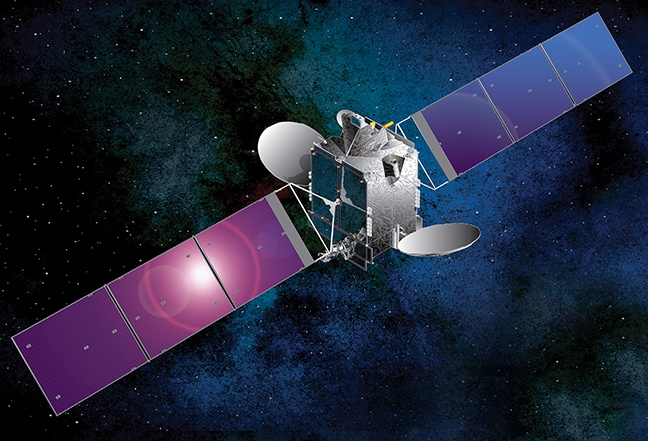
The successful launch of the Optus-10 satellite took place in French Guinea, in September 2014. As the tenth satellite to be successfully launched, Optus-10 further extends our satellite fleet. Operating in the Ku-Band, the Optus-10 satellite brings increased fleet resilience and additional capacity to deliver voice, data and video services across mainland Australia, New Zealand and Australia's surrounding islands and territories.
|
Satellite |
|
|
Satellite Type: |
SSL LS1300 LL |
|
Launch Mass: |
3270 kg |
|
Mass in Orbit: |
1677 kg |
|
Stablisation: |
3 Axis Momentum Stabilised |
|
Dimensions: |
24.8 metres across extended solar panels |
|
Transponders |
|
|
Operating Bands: |
Ku-Band |
|
Uplink Frequencies: |
Ku FSS: 14.0 - 14.5 GHz Ku BSS: 17.3 – 17.8 GHz |
|
Downlink Frequencies: |
Ku FSS: 12.25 - 12.75 GHz Ku BSS: 11.7 – 12.2 GHz |
|
Number of Transponders: |
24 Ku-Band @ 133 W |
|
Bandwidth: |
36 MHz |
|
Polarisation: |
Linear |
|
Performance |
|
|
EIRP: |
Australia 44 to 51 dBW Australia/New Zealand combined 44 to 50 dBW (see the Technical Information document for detailed contour maps)
|
|
G/T: |
Australia -2 to 7 dB/K Australia/New Zealand combined -1 to 6 dB/K (see the Technical Information document for detailed contour maps)
|
|
SFD: |
-65 to -101 dBW/m2 (at +2dB/K G/T contour) |
|
Solar Array Power: |
7700 watts (at end of life) |
|
Telemetry: |
Ku-Band |
|
Command: |
Ku-Band |
More from Optus
Customer Service
About Us
Connect with us
